

When it comes to medical supplies, the Absorbent Cotton Wool Roll is a staple product that has been widely used in various settings, from hospitals and clinics to home first - aid kits. As a supplier of Absorbent Cotton Wool Rolls, I have had the opportunity to observe its behavior when coming into contact with different types of liquids. This exploration not only deepens our understanding of the product but also helps in better serving the needs of customers.
Absorbent Cotton Wool Rolls: An Introduction
Before delving into its interaction with different liquids, let's briefly understand what an Absorbent Cotton Wool Roll is. It is made from high - quality cotton fibers that are processed to enhance their absorbent properties. The cotton is carefully spun and rolled into a convenient form, which can be easily cut to the desired length. This makes it highly versatile for a range of applications, such as wound dressing, cleaning, and applying medications. You can find more information about our Absorbent Cotton Wool Roll on our website.
Interaction with Water
Water is the most common liquid that an Absorbent Cotton Wool Roll encounters. When a roll comes into contact with water, it starts to absorb the liquid rapidly. The cotton fibers have numerous small spaces between them, which act as capillary channels. These channels draw the water in through capillary action, a phenomenon where a liquid moves through narrow spaces without the assistance of, or in opposition to, external forces like gravity.
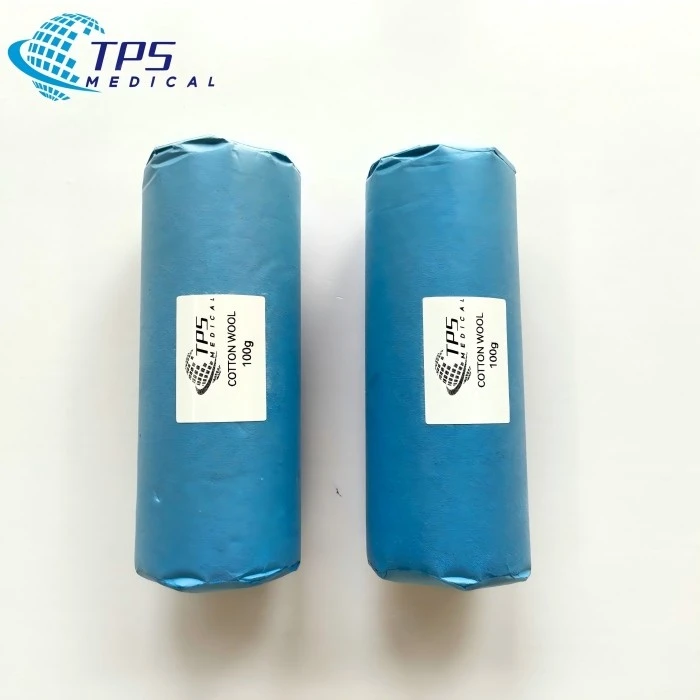

The rate of absorption depends on several factors. Firstly, the density of the cotton wool roll plays a role. A less - dense roll will generally absorb water more quickly as there are more open spaces for the water to penetrate. Secondly, the fibers' surface area also matters. Finer fibers have a larger surface area in contact with the water, which facilitates faster absorption. Within seconds of being dipped in water, the outer layers of the roll become saturated, and gradually, the water spreads throughout the entire roll. This high water - absorbing capacity makes it ideal for cleaning up spills and for wound care, where it can effectively soak up exudate from wounds.
Reaction with Alcohol
Alcohol is another common liquid used in medical and cleaning applications. When an Absorbent Cotton Wool Roll is exposed to alcohol, the absorption process is similar to that of water but with some differences. Alcohol has a lower surface tension compared to water. Surface tension is the force that causes the surface of a liquid to behave like an elastic film. Due to its lower surface tension, alcohol can penetrate the cotton fibers more easily and quickly.
However, alcohol also has a lower viscosity than water. Viscosity refers to a liquid's resistance to flow. The lower viscosity means that alcohol can spread more rapidly within the roll once it starts to be absorbed. This property makes Absorbent Cotton Wool Rolls soaked in alcohol excellent for disinfection purposes. They can be used to clean medical instruments, wipe down surfaces, and sanitize the skin before injections or minor medical procedures. You may also be interested in our Soft Cotton Ball, which also works well with alcohol for similar applications.
Behavior with Oil - based Liquids
Oil - based liquids, such as petroleum jelly or essential oils, interact with Absorbent Cotton Wool Rolls in a different way compared to water and alcohol. Oils have a higher viscosity and a different molecular structure. When the roll comes into contact with oil, the absorption process is slower. The cotton fibers need more time to break through the oil's cohesive forces and draw it into the roll.
The hydrophobic nature of some oils can also pose a challenge. Hydrophobic substances repel water and have a tendency to form droplets rather than spread evenly. This means that the oil may not distribute uniformly within the roll. However, once absorbed, the oil - soaked roll can be used for applications like moisturizing the skin or lubricating small mechanical parts. The ability to hold oil makes the Absorbent Cotton Wool Roll a useful tool in the beauty and maintenance industries.
Effect of Chemical Solutions
Chemical solutions in medical and laboratory settings also have unique interactions with the Absorbent Cotton Wool Roll. For example, saline solutions are commonly used for wound irrigation. When the roll is placed in a saline solution, it absorbs the solution just as it does with water, but the presence of salt can have an impact on the fibers over time. High - concentration saline solutions may cause the cotton fibers to become stiffer due to the salt crystals that can form within the fibers as the water evaporates.
On the other hand, acidic or alkaline solutions can react with the cotton. Strong acids or alkalis can potentially damage the cotton fibers, breaking down their molecular structure and reducing the roll's absorbency. Therefore, when using Absorbent Cotton Wool Rolls with chemical solutions, it is crucial to choose the appropriate roll based on the nature of the solution. Our Absorbent Cotton Gauze Roll is also a great option for handling different chemical solutions in certain applications.
Influence of Temperature
Temperature can significantly affect how an Absorbent Cotton Wool Roll behaves when in contact with liquids. When the liquid is at a higher temperature, its molecules have more kinetic energy, which means they move more freely. This increased movement facilitates the penetration of the liquid into the cotton fibers. For example, warm water will be absorbed more quickly than cold water.
Conversely, at lower temperatures, the liquid's viscosity may increase, and the molecules move more slowly. This can slow down the absorption process. In a cold environment, if you need to use the Absorbent Cotton Wool Roll with a liquid, you may notice that it takes longer for the roll to become saturated.
Conclusion and Call to Action
The behavior of an Absorbent Cotton Wool Roll when contacting different types of liquids is a complex but fascinating topic. Understanding these interactions is essential for using the product effectively in various applications, whether it's in the medical field, household cleaning, or industrial settings.
As a supplier of high - quality Absorbent Cotton Wool Rolls, we are committed to providing products that meet the diverse needs of our customers. If you are interested in learning more about our products or have any specific requirements, we encourage you to reach out to us for further discussions and potential procurement. We are here to assist you in finding the most suitable solutions for your needs.
References
- Principles of Fluid Mechanics and Heat Transfer, relevant chapters on capillary action and liquid - solid interactions.
- Textile Science textbooks, covering the properties of cotton fibers and their behavior with different substances.
- Medical and Laboratory Manuals, detailing the use of absorbent materials with various liquids.